



The Early Childhood Education Profession

Subscribe for advocacy updates and information about the ECE Profession Bill.

It's time to recognize early childhood educators as professionals!

In Vermont there are approximately 6,500 early childhood educators working in center-based and home-based programs. Most of our youngest children, and all of our infants and toddlers in regulated child care, attend these programs.

Vermont lawmakers are considering a bill that would create a license to practice as an Early Childhood Educator ECE) for people working in these non-public programs. This isn’t top-down regulation — it’s something Vermont ECEs have been working toward for years.

Licensure supports transparency for families and hiring directors, clear and well-resourced career pathways for ECEs, improved access to care for families, greater public recognition of the essential work early childhood educators do, and most of all: better outcomes for children, in kindergarten and beyond.

ECE Profession Bill: 2025 Legislative Recap Video

Get up to speed by viewing this short video hosted by Beth Wallace of VTAEYC.

In January 2025, Vermont’s Office of Professional Regulation (OPR) recommended lawmakers consider legislation to create an Early Childhood Education Profession. A bill was introduced and passed, with amendments, by the Vermont Senate. The Vermont House will take up the bill in 2026. 

A Profession Supports Best Outcomes for Young Children

Transparency, trust, and access for families.

Children with highly qualified early childhood educators are more likely to succeed in kindergarten and beyond. Aligning early childhood educator qualifications across all settings ensures every child has a strong start, no matter where they receive care. And when ECEs have access to clear, well-resourced career pathways, more children have access to quality programs.

A young boy skips to greet his mother who stands with arms extended while his teacher smiles at them both.
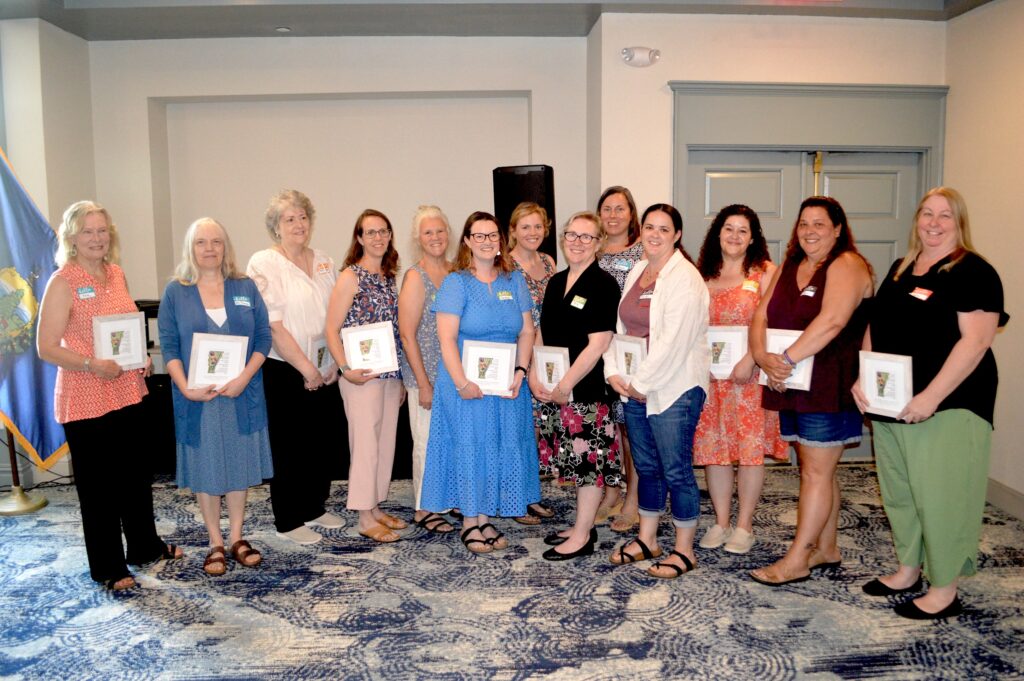
A line of women holding plaques in a ballroom

A Profession For ECEs, Designed By ECEs

Momentum is building for an ECE Profession recognized across states.

Vermont’s ECE workforce developed the recommendations that shaped the ECE Profession Bill, which are also aligned with national recommendations. A Task Force of early childhood educators led this work.

Vermont is special for its important investments in our early childhood system — and with public funding comes accountability to the public through regulation. The ECE Profession Bill is an opportunity to shape the way we’re regulated. Our workforce leadership is recognized by the Commission on Professional Excellence in Early Childhood Education as a model for other states.

Respect for Quality in Home-Based and Center-Based Programs

 Elevating Family Child Care Home and Center-Based ECEs.

A license to practice gives early childhood educators a professional identity, clear career pathways, and a way to communicate our skills and expertise, no matter what setting we work in — just like nurses and other licensed professionals.

Chris Nelson, who runs a family child care home in North Troy, told legislators: “Quality isn’t determined by the door you walk into. All children deserve the same high-quality care, regardless of zip code or what kind of program they attend.”

People stand at an outdoor rally holding signs that say "For Educators" and "For Children"

A Long, Supported Transition — With ECE Leadership

The ECE Profession Bill includes an 8-year transition period with flexible resources and supports.

Nobody would lose their job or have to close their program as a result of this bill. All currently working early childhood educators in regulated programs qualify for a renewable transition license and access to supports.

The ECE Profession Bill would create a Governing Board to define the rules for the profession. All ECE license designations will be represented on that board — and the rulemaking process will include even more opportunities for workforce input.

Our Pledge: To Keep You Informed

The ECE Profession Bill will impact early childhood educators in CDD-regulated family child care home-based and center-based programs. As your professional association, VTAEYC pledges to keep you informed about the bill’s progress, changes to the bill, and ways you can advocate.

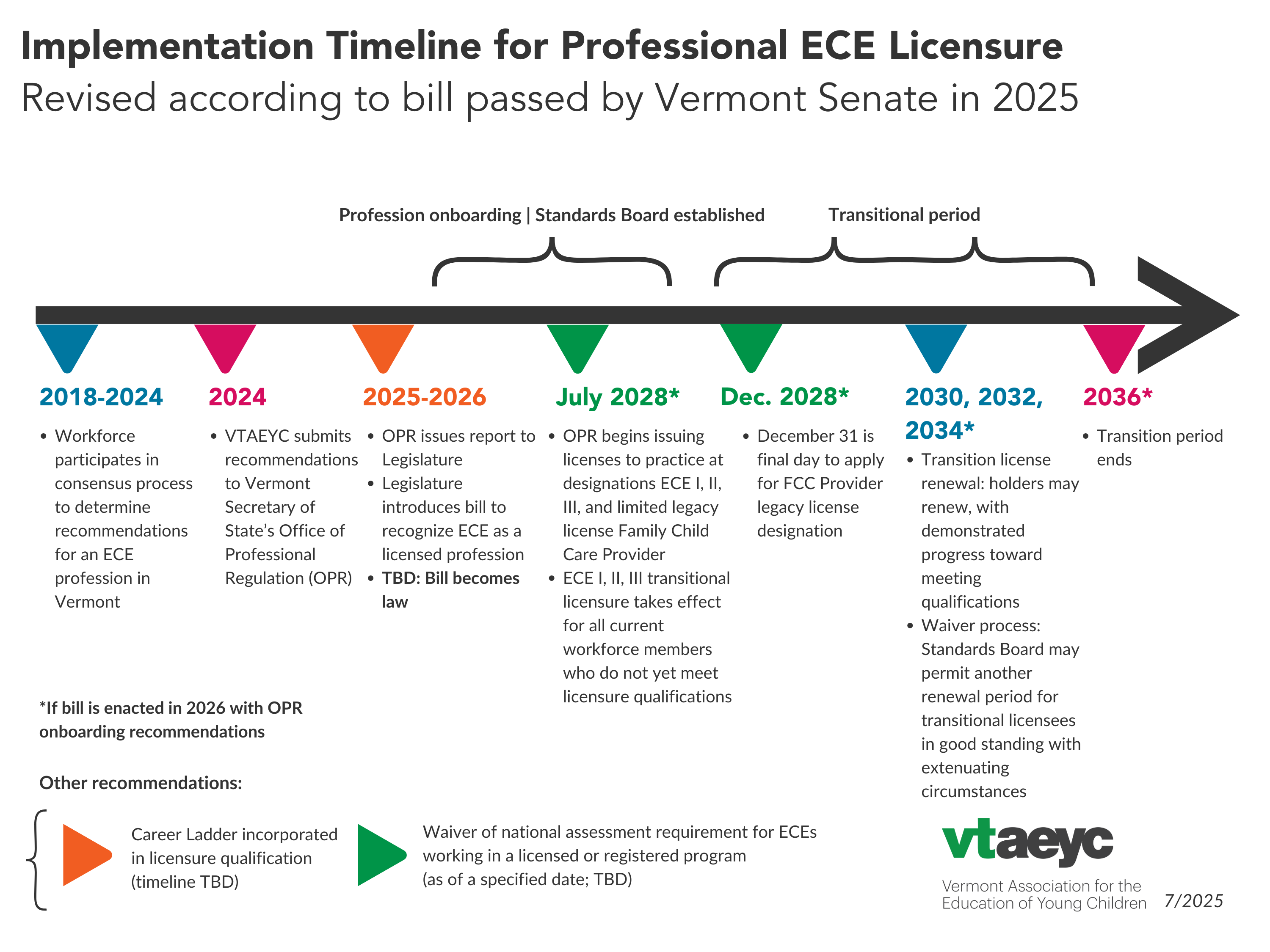
A graphic showing the implementation timeline of the ECE Profession Bill as passed by the Vermont Senate in 2025. The Bill will be taken up by the Vermont House in 2026.

Proud To Be an ECE!

Being a professional early childhood educator means having a shared professional identity. Whether we work in family child care homes or center-based programs, our expertise means Vermont children reach kindergarten ready to learn. That’s why ECEs from around the state say We’re In! for the ECE Profession. Because we’re proud to be an ECE!

ECE Profession FAQs

Professional recognition for early childhood educators in non-public programs fills gaps in our current system, means more children will have access to child care and families can go to work, and ensures all children have the opportunity to benefit from high-quality early experiences that lead to better outcomes in kindergarten and beyond. Individual professional licensure to practice protects the public and strengthens the ECE workforce. 

The Office of Professional Regulation (OPR) determined that individual licensure for early childhood educators is necessary to protect children and families from harm. In Vermont there are approximately 6,500 early childhood educators working in non-public child care programs regulated by the Child Development Division. Most of Vermont’s youngest children, and all of its infants and toddlers in regulated child care, attend these programs. There is not currently a system of individual regulation that supports aligned qualifications and accountability for these educators. 

Research shows that the professional qualifications of a child’s early childhood educator is the number one indicator of quality in that child’s early experiences (National Institute for Early Education Research, NIEER). Licensing educators in non-public child care programs ensures educators in family child care home-based and center-based settings have standard qualifications, meaning that children have consistent quality experiences no matter what type of program they attend.

Professional recognition brings value and respect to early childhood educators. A license to practice gives early childhood educators a professional identity, clear career pathways, and a way to communicate their expertise: just like nurses and other licensed professionals. 

Vermont is among a cohort of states leading the way toward a future where early childhood education is a licensed, portable, national profession. This opens doors for educators, improves hiring, attracts educators, families, and workers to Vermont, and raises the field’s status nationwide.

According to the recommendations of the Office of Professional Regulation (OPR), the ECE Profession Bill would impact early childhood educators working in non-public child care programs regulated by the Child Development Division. That means educators working in center-based and home-based programs.

Educators in public schools are licensed through the Agency of Education (AOE) and are not impacted.

Educators working in non-public programs but who have active AOE teacher licensure with ECE endorsement already meet all qualifications and are exempt from needing an additional ECE licensure through OPR.

Vermont’s Office of Professional Regulation (OPR), an office of the Secretary of State, submitted a report to the Legislature in January 2025 that recommended Vermont professionally recognize and license early childhood educators through OPR. That report prompted lawmakers to introduce legislation in both Vermont’s House and Senate.

OPR’s recommendations are aligned with recommendations made by Vermont’s workforce and made by the national Commission on Professional Excellence in Early Childhood Education.

VTAEYC is tracking the ECE Profession Bill and is committed to keeping the ECE workforce updated with accurate information. If you have specific questions about the bill, please contact the Office of Professional Regulation (OPR) at sos.vermont.gov/opr.

Workforce voice is essential to building a profession that works for early childhood educators. The elements in the ECE Profession Bill are based on recommendations made by a Task Force of Vermont early childhood educators, through a multi-year feedback process that engaged at least a thousand in the ECE workforce. 

Early childhood educators provided comment to the Office of Professional Regulation (OPR) and testimony to Vermont’s Senate Committee on Government Operations. This workforce feedback helped shape both the recommendations of OPR and revisions to the bill that was ultimately passed by the Vermont Senate in 2025. Early childhood educators will also provide testimony when the Vermont House takes up the bill.

If the bill becomes law, early childhood educators will continue to shape the profession. The ECE Profession Bill establishes a governing board made up of early childhood educators, ensuring representation from each licensure designation (ECE I, II, III, and if passed, the limited designation Family Child Care Provider). This ensures ECE regulatory leadership, and creates a transparent system for future ECEs to engage with their peer-led regulatory governing board. In addition, the regulatory rulemaking process includes a substantial public comment period.

Absolutely not. You deserve credit for the skills you’ve built over your years of experience, and the bill must include flexible ways for you to get that credit.

Retention efforts in the ECE Profession Bill are designed to reduce stress and barriers and to ensure no early childhood educator working today will lose their job as a result of this bill. Every early childhood educator currently working in a regulated program, who does already meet qualifications for ECE II or ECE III, automatically qualifies for transition licensure.

Proposed and existing transition supports include an 8-year transition timeline, debt-free education options, and prior learning assessment (PLA, or show-what-you-know) options to demonstrate expertise.

Additional bill amendments passed by Vermont’s Senate allow for a “legacy” license specifically to retain current family child care home educators who are unlikely to pursue an associate degree.

VTAEYC will never advocate for policies that harm early childhood educators. We will monitor the bill and keep you informed about changes and about opportunities to advocate, and continue to provide resources to help educators increase their qualifications.

Act 76 (2023) created state investment and stable funding streams to help move program reimbursement closer to the true cost of care. This funding system was also identified as a way to support, but not mandate, increasing compensation. In 2026, the Department of Labor and Child Development Division are scheduled to report to the Legislature regarding minimum compensation standards for early childhood educators.

A minimum standard defines the floor, not the ceiling, for compensation. It’s a framework to raise compensation quickly and fairly. 

VTAEYC advocates for fair compensation that increases as preparation increases. This table reflects a model minimum compensation standard informed by feedback from Advancing ECE as a Profession workforce surveys and ecosystem research. That work from 2022 was included in the RAND Corporation financing study commissionedby the Vermont legislature to determine the cost of transforming early childhood education. This table has been updated by Let’s Grow Kids to reflect the years that ECE Profession implementation is projected to begin.


No, you will not. Educators licensed by the Agency of Education (AOE) with early childhood education endorsement are already licensed for the work they do with young children and meet all qualifications for ECE III licensure through OPR. To avoid redundancy, AOE-licensed educators working in non-public programs would be exempt from also needing ECE licensure through OPR.

AOE (Agency of Education) licensure is a separate regulatory system than the Office of Professional Regulation (OPR). AOE licensure with ECE endorsement requires a bachelor’s degree, a portfolio process, and passing the Praxis exam. AOE licensure qualifies an individual to work in public schools regulated by AOE. It is also required for delivering Universal Pre-K in non-public school partner programs.

The proposed system of ECE licensure through OPR is designed for people working in non-public early childhood education programs regulated through the Child Development Division (CDD).

The proposed ECE licensure system has three tiers for different qualifications: ECE I (120 clock hours), ECE II (Associate degree), and ECE III (Bachelor’s degree). These qualifications stack to create clear career pathways for any ECE at any point in their career. Ample supports are available to help working early childhood educators increase their qualifications.

The OPR licensure system aligns with public school standards and competencies and is designed to fit into existing regulatory systems. Educators with an ECE III license could choose to continue increasing their qualifications by completing the portfolio and exam requirements for AOE licensure. 

Not every early childhood educator with a bachelor’s degree has a reason to pursue AOE licensure. For example, lead teachers in infant and toddler classrooms do not engage with Universal Pre-K. Meanwhile, the national quality standard (NIEER) requires bachelor’s degrees for lead teachers in ECE programs, but CDD regulations do not. For these reasons, ECE III is a necessary designation to both recognize and compensate ECEs with bachelor’s degrees, and to move Vermont’s non-public programs toward national quality standards.

According to OPR-recommended revisions in the version of the ECE Profession Bill that passed the Senate, you probably do—or you’re close!

New language in the revised bill clarifies these qualifications:

ECE II: Associate degree in early childhood education or a related field, or: associate degree in any unrelated field, plus a minimum of 21 college credits in core ECE competency areas.

ECE III: Bachelor’s degree in early childhood education or a related field, or: bachelor’s degree in any unrelated field, plus a minimum of 21 college credits in core ECE competency areas.

Field experience is also required.

Being a licensed professional helps you get recognition and respect for the essential work you do. It corrects the misconception that there is any difference in quality between family child care home (FCCH) programs and other program settings, because the qualifications are the same and the license structure is easy for families and the public to understand. It’s like nursing: if you have a nursing license, you might work in a hospital, a memory care center, or a summer camp—and you’re still recognized as a nurse.

Because licensure connects compensation to individual qualifications instead of basing it on setting, this system could support fairer compensation across settings, in particular for family child care home owners.

While many FCCH owners support the ECE Profession Bill, some have raised concerns that it could harm FCCH owners who do not have an associate degree, which would be the qualification for the ECE II license. ECE II would be the license required to operate a regulated home-based program. 

To address this, all current early childhood educators are eligible for a transition license while they work to increase their qualifications. Supports include an 8-year transition timeline, debt-free education options, and prior learning assessment (PLA, or show-what-you-know) options to demonstrate expertise. Additional bill amendments passed by Vermont’s Senate allow for a time-limited “legacy” license (Family Child Care Provider) specifically to retain current family child care home educators who are unlikely to pursue an associate degree.

If you qualify for an ECE I or ECE II license—if you have a CDA or 120 clock hours, or an associate’s degree—you will experience transparency around compensation standards, consistent work expectations for your qualifications, clarity around what you are qualified to do and what your next career moves could be, and the recognition that comes with being a licensed professional.

If you qualify for ECE III, you will experience recognition for your bachelor’s degree-level preparation. The Northern Lights Career Ladder provides bonuses for earning bachelor’s degrees, but there is no ongoing leadership or compensation structure to recognize bachelor’s degrees—which is the nationally recognized quality standard for a lead teacher in child care programs. This recognition is especially important for infant and toddler teachers and others who may not have a reason to pursue AOE teacher licensure with ECE endorsement.

If you are a center director, an individually licensed hiring pool simplifies hiring. Programs will have a clear understanding of the qualifications of each licensed applicant for a given position. And a system of individual regulation helps protect your program against the risks involved with hiring people who are not qualified to practice.

While many center directors support the ECE Profession Bill, some have raised concerns that increasing qualifications will shrink an already too-small workforce, making it harder to fill positions with qualified applicants.

To address this, all current early childhood educators are eligible for a transition license while they work to increase their qualifications. Supports include an 8-year transition timeline, debt-free education options, and prior learning assessment (PLA, or show-what-you-know) options to demonstrate expertise. Some individuals may choose to leave early childhood education for other careers, but based on our workforce data, more people want to join the field when there are ample career supports and clear paths. As the profession becomes more attractive and accessible, the hiring pool will grow, become more qualified, and show commitment to the career. The 8-year transition timeline is critical to smoothing the transition for center directors.

A highly qualified ECE workforce aligned with the same standards and competencies as public school teachers supports improved child outcomes in kindergarten and beyond. Teachers at all grade levels benefit when children have access to highly qualified early childhood educators.

ECE coordinators benefit from clarity about the individual qualifications of early childhood educators when working to place children in their district with the programs that best meet each child’s needs.

The professional promise of clear career pathways, career supports, and fair compensation draw early childhood education students to ECE preparation programs. The ECE I, II, III designations provide objective criteria that can be used across settings to understand an individual’s qualifications to support, lead, or guide. In addition to determining qualifications for non-public early childhood educator positions, they can be used to help higher ed institutions identify qualified mentor teachers for fieldwork placements.

Professionalizing early childhood education gives families peace of mind. It’s a layer of assurance and accountability to families that their children are safe, well cared for, and receiving the high-quality education they need to thrive in kindergarten and beyond. It means families can trust that no matter what kind of program their child attends, their child’s educator meets clear, consistent qualifications. 

Regulation through the state’s Office of Professional Regulation (OPR) creates transparency. It supports stability among program staff, with educators who are well-prepared, fairly compensated, and committed to their work with young children. 

The details get worked out in the rulemaking process, after the bill becomes law. Professions are established through legislation. The ECE Profession Bill lays the foundation: it defines what the early childhood education profession is, what it does, and who it includes. 

Once the bill becomes law, the rulemaking process starts, where regulations are translated into practice. This is why bill language does not include a lot of the specific details for how the profession will be implemented. The rulemaking process invites stakeholders — those most impacted by the legislation — to participate, ensuring the field has a say in how the profession is shaped.

Down the road, licensing individual educators can lead to more streamlined regulation over time. People impacted by the ECE Profession Bill work in programs regulated by the Child Development Division (CDD). Right now, many program-level regulations exist because there is no system to verify the qualifications of individual educators. By establishing licensure for the workforce itself, Vermont will finally have a way to ensure the people caring for young children meet professional standards. Over time, this could allow the state to simplify or reduce some program regulations.

The Office of Professional Regulation (OPR) typically requires license renewals every two years. License fees are designed to increase only as qualifications and compensation increase. VTAEYC advocates for adequate compensation to come first so that license fees do not create financial burdens. 

ECE I: 

Application for initial license, $125.00

Biennial renewal, $225.00

ECE II:

Application for initial license, $175.00

Biennial renewal, $250.00.

ECE III:

Application for initial license, $225.00

Biennial renewal, $275.00

Terms for the limited Family Child Care Provider license added in the Senate’s revision: Application for initial license, $175.00. Biennial renewal, $250.00.

Northern Lights is a partner in designing recommendations for how Career Ladder credentials will mesh with the national recommendations for licensure qualifications. We plan to continue this partnership.

The Child Development Associate credential (CDA) is a well-known national qualification held by many early childhood educators. How it fits into professional recommendations is something the national Commission on Professional Excellence in ECE is still considering, and would be addressed in the rulemaking process after legislation is passed. It is at minimum a qualification for ECE I.

VTAEYC can help connect you to the resources you need! 

If you do not yet qualify for ECE I, II, or III, or if you would like to qualify for a different designation, VTAEYC administers scholarships, student loan repayment assistance, grants, career advancement resources, and other incentives to help early childhood educators earn qualifications at no or low cost.

There are innovative and flexible pathways for early childhood educators at all career stages to earn transferable, stackable credentials. We can help set you in the direction that’s best for you. See our Career Advancement page to get started.

The Commission on Professional Excellence in ECE works with state and federal bodies, state and federal agencies, and regulators to promote alignment with the recommendations of the Unifying Framework for the ECE Profession. Read more about the Commission’s work here.

Vermont is one of several states taking steps to implement the recommendations of the Unifying Framework. In June 2025, the Commission reported that in addition to Vermont, the District of Columbia and Missouri are taking steps to align with ECE I, II, and III designations.

Other states working on more than one of these categories—investing in higher ed, attending to wages and/or benefits, and adopting the Professional Standards and Competencies—include: Alabama, Connecticut, District of Columbia, Michigan, Pennsylvania, Rhode Island, and Washington.

The Commission considers Vermont’s workforce-led efforts a model. We have been asked to meet with fellow states to share with and learn from each other.

Request A Presentation

ECE Profession project leaders are available to present updates to networks and system groups.